
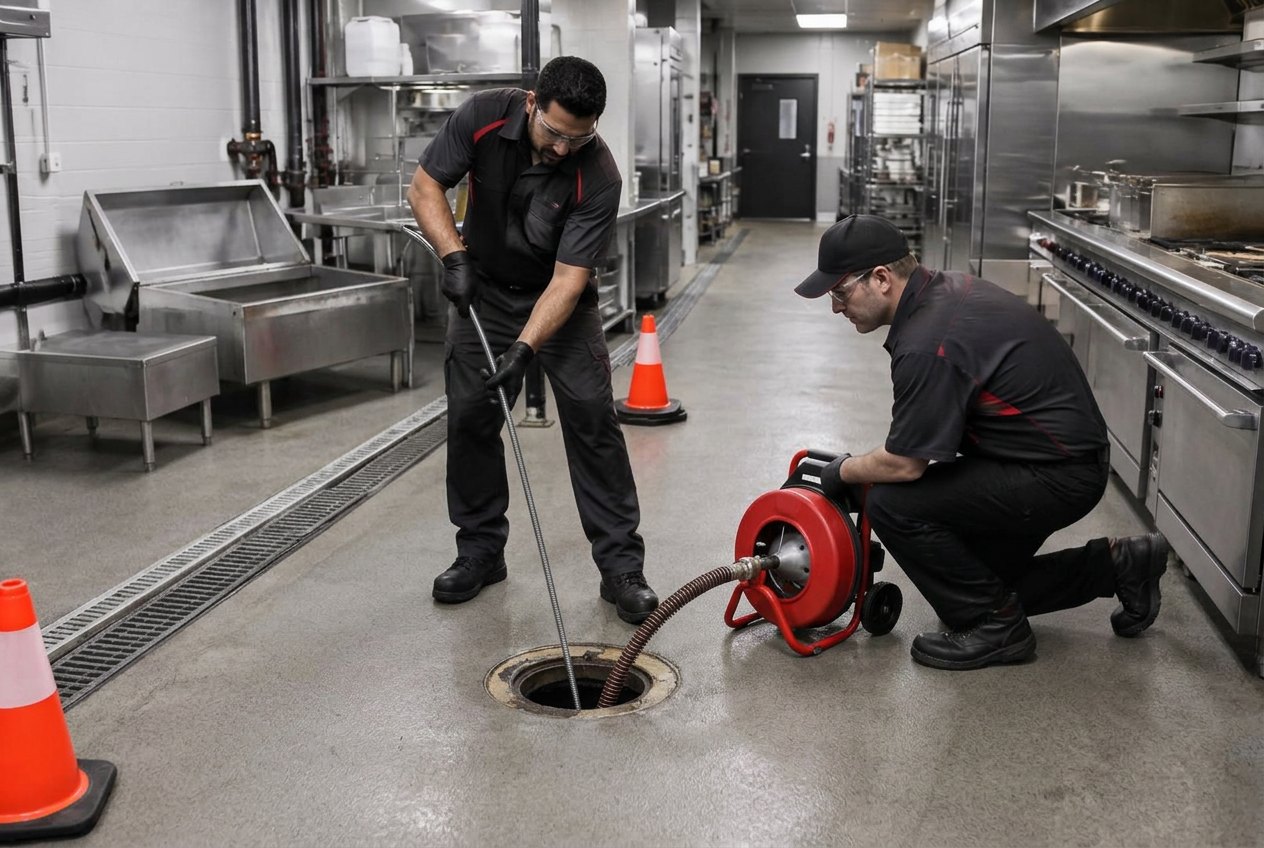
The right commercial drain maintenance schedule is based on use, consequence and evidence. A restaurant kitchen main and a lightly used office lateral should not receive the same interval. Austin facility teams get better results by establishing a clean baseline, tracking what returns and adjusting the schedule before a blockage interrupts tenants, production or public access.
Build the schedule from risk, not a generic calendar
Start by listing critical lines and asking what happens if each one stops flowing. Give the shortest interval to lines that carry grease, solids or heavy daily volume, and to lines where an overflow would close operations or damage occupied space. Lower-use lines can be inspected on a longer cycle, but they still need a documented baseline.
Practical starting intervals by facility type
- Commercial kitchens and food-service tenants: inspect and clean high-use kitchen branches and grease-bearing mains every 3 to 6 months, then adjust from measured buildup
- Multifamily and HOA common lines: review known problem stacks and building mains every 6 to 12 months, with shorter cycles for repeat grease or root conditions
- Retail and office properties: inspect critical mains annually and after tenant improvements that change fixture load or disturb underground lines
- Industrial and production sites: set intervals from the material entering each drain, process shutdown risk and environmental requirements
- Municipal and campus systems: prioritize segments using condition history, blockage calls, pipe age, critical users and wet-weather performance
Choose the treatment that matches the evidence
Cable clearing for a defined obstruction
Mechanical rooter equipment is appropriate when a specific obstruction must be opened quickly and the line condition is otherwise understood. It restores a flow path but may not remove wall-to-wall grease, scale or sediment.
Hydro jetting for full-line cleaning
High-pressure jetting is the stronger maintenance tool when buildup coats the pipe wall or recurring debris must be transported out of the system. Nozzle selection, pressure and flow should match the pipe material, diameter and condition.
CCTV to verify the result
A post-cleaning camera pass confirms that the material was removed and reveals defects hidden by buildup. It also gives the facility team evidence for changing the next maintenance interval instead of repeating the same schedule by habit.
Records that make preventive maintenance work
- A line map with stable names for cleanouts, manholes and building mains
- Service date, cleaning method, nozzle or cable used and total footage
- Observed grease, roots, scale, sediment or foreign material
- Before-and-after video for critical lines
- Defect locations and recommended repair or monitoring dates
- The next planned service date and the reason for that interval
When to shorten the interval
Move the next service forward when backups recur sooner, cleaning removes heavy material, a camera shows roots or an offset that catches debris, tenant use changes, or construction sends sediment into the system. A structural defect needs a repair decision, not endless cleaning. Maintenance should control predictable buildup, not hide a failing pipe.
Commercial drain maintenance questions
- How often should a commercial drain be cleaned?
- There is no single interval. High-use grease lines may need service every 3 to 6 months, while lower-risk office mains may be reviewed annually. Inspection history should determine the final schedule.
- Should every maintenance visit include a camera?
- Critical lines benefit from periodic before-and-after video. A camera is especially valuable when the removed material is heavy, backups recur or the team needs to distinguish buildup from structural failure.
- Does preventive maintenance replace a pipe repair?
- No. Cleaning controls deposits and restores capacity. Cracks, offsets, bellies and collapsed sections require engineering or repair decisions based on condition and consequence.