
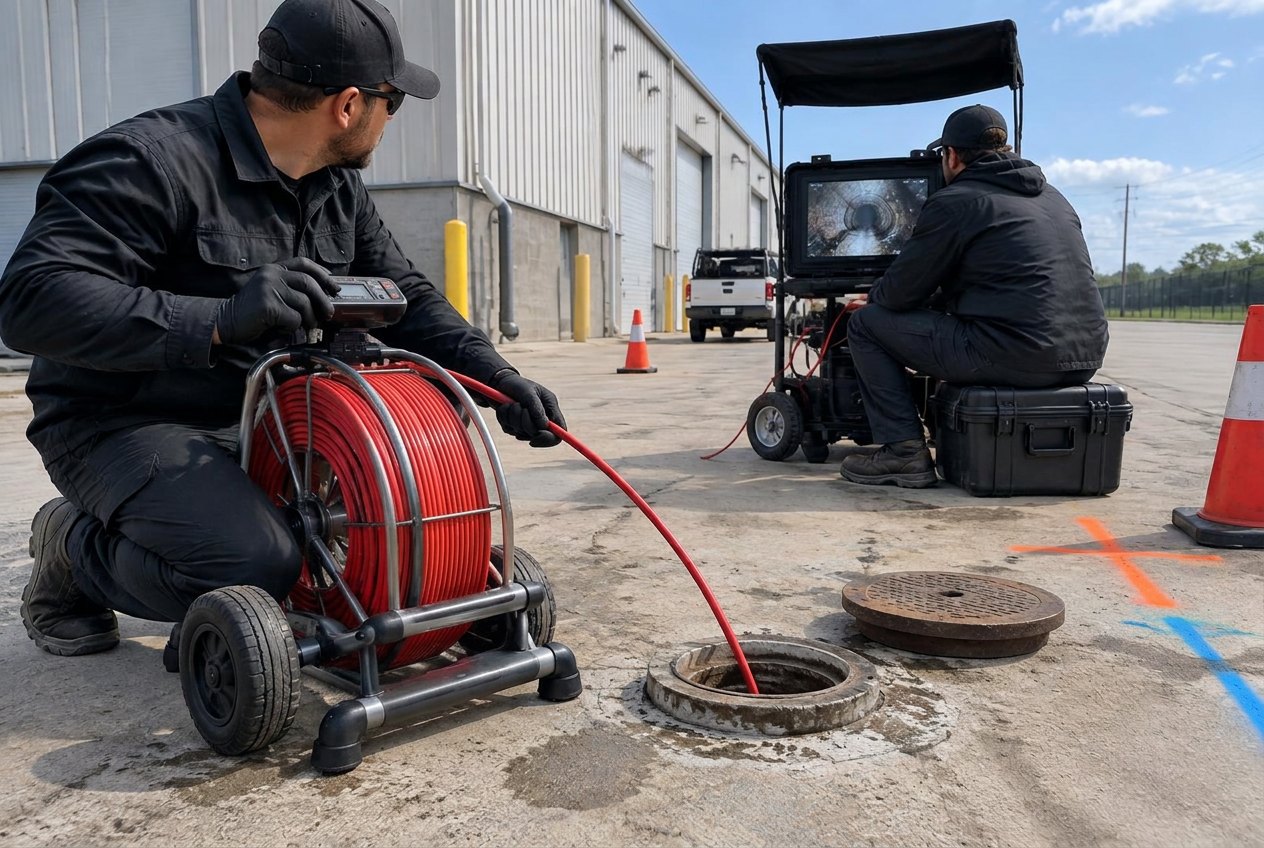
A sewer camera report is useful when it separates what the camera saw from what the project team should infer. Roots, standing water, offsets, cracks and debris do not all mean the same thing, and none should be judged from a single blurry frame. The operator should document location, extent, surrounding pipe condition and whether flow or access limited the observation.
Roots
Roots enter through an opening such as a separated joint, crack or failed connection. Cutting restores capacity but does not close the entry point. The report should show the footage, density, pipe material and visible source. Reinspection after cleaning helps reveal the underlying defect and supports a lining, point-repair or monitoring decision.
Bellies and standing water
Standing water may indicate a low section, but the camera alone does not measure grade. Flow conditions, debris and camera orientation can change how deep it appears. A useful report records the start and end footage, estimated depth relative to pipe diameter and whether the camera remained submerged. Survey data or additional testing may be needed before specifying correction.
Offsets and separated joints
An offset occurs when connected pipe ends are no longer aligned. Severity depends on how much of the opening is displaced, whether soil is visible, whether material catches at the joint and whether the camera can pass. New-construction acceptance standards and existing-system maintenance decisions may treat the same visual condition differently, so the report must preserve evidence rather than jump directly to a repair claim.
Cracks, fractures and broken pipe
A single longitudinal crack, multiple fractures and a visibly broken section represent different structural conditions. The report should include more than one view when possible and identify deformation, missing wall material, infiltration or soil. PACP coding can standardize the observation for an engineer or asset owner, while repair design remains a separate decision.
Grease, scale, sediment and construction debris
Deposits are operational conditions until they conceal the pipe wall or repeatedly reduce capacity. Grease tends to coat the wall, mineral scale narrows the opening, sediment settles in low-flow areas, and construction debris can create a hard obstruction. Cleaning followed by another camera pass distinguishes a removable maintenance condition from a structural defect underneath.
Intruding connections and protruding taps
A lateral or tap that extends into the main can catch debris, disrupt cleaning equipment and reduce capacity. The report should show the clock position, intrusion depth and footage. On acceptance work, compare the observation with the project specification. On existing systems, combine severity with blockage history and downstream consequence.
What a responsible recommendation looks like
- Clean and reinspect when deposits or roots hide the pipe wall
- Monitor when a minor condition is stable and consequence is low
- Surface-locate when a point repair, excavation or lining termination may follow
- Request engineering review when grade, structural capacity or rehabilitation design is involved
- Escalate promptly when the camera shows collapse, active soil entry or a condition threatening operations
Questions about camera findings
- Does standing water always prove a sewer belly?
- No. It can suggest a low section, but flow, debris and camera orientation affect the image. Document the extent and depth, then use survey or other evidence if a grade decision is required.
- Will cutting roots solve the problem permanently?
- Root cutting restores capacity but does not close the opening where roots entered. Reinspection should identify the joint or crack so the owner can choose monitoring, lining or repair.
- Can a camera determine whether lining will work?
- Camera inspection is a key qualification step, but the lining contractor or engineer must also consider cleaning results, pipe continuity, diameter changes, access and the selected rehabilitation system.
- Who decides whether a defect fails a new Austin project?
- Acceptance comes from the applicable plans, specifications and reviewing authority. The inspection operator documents the condition and coding; the engineer, owner or municipality applies the project standard.